Home / IPTV Subscription in the USA: What It Costs and Who Covers What
US coverage, US prices
IPTV Subscription in the USA: What It Costs and Who Covers What
Published by IPTV Subscription Review · Prices checked August 2026
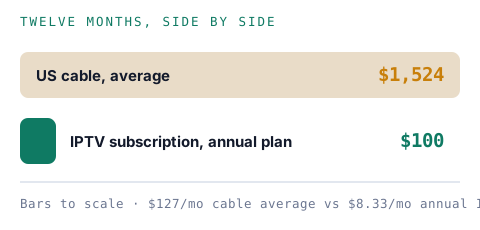
A US IPTV subscription costs $8.33 to $15 a month for one connection in 2026 — $15 billed monthly on every service here, $100–$120 for the year. Against an average US cable bill of about $127 a month, that is roughly a tenth of the cost. EarthWebTV is built specifically around US and Canadian line-ups; TereaTV is the strongest all-round option for American viewers.
Disclosure: eight of the subscriptions on this page — TereaTV, FreeGoTV, VocoTV, BexyTV, KroozTV, ViewTVY, VinomTV and EarthWebTV — are operated by the same network that publishes this site, which is why we can publish verified plan figures for them. Everything else listed is a third-party service, flagged as unverified. How ownership affects this comparison.
American households are not leaving cable because streaming is fashionable. They are leaving because $127 a month buys 200 channels of which fewer than ten get watched, plus equipment rental, plus regional surcharges, plus a contract.
The arithmetic American households are running in 2026.
What matters for a US buyer is narrower than the global feature lists suggest: do you get your local affiliates, does the guide carry US listings correctly, and does the stream hold up on a US connection during evening peak on the East Coast.
The bill, line by line
Same household, same twelve months, both bills itemised.
Figures are the effective cost per month once the billing term is divided out — the number you actually pay, not the headline rate. Provider-listed figures checked in August 2026; verify the current total at checkout; see our disclosure.
Why here: Best all-round option for US viewers, and $10 a month from the six-month plan.
Strength: Provider-listed plan terms that still need a peak-time trial, and the six-month plan already hits $10 a month — you do not have to commit to a year to get the best rate.
Trade-off: The annual plan costs $120 while two rivals charge $100 for the same twelve months.
Why here: The household pick — five simultaneous streams on one American bill.
Strength: Extra devices cost $5 each rather than a full extra plan — six simultaneous streams is $40 a month, which works out to $6.67 per device, the lowest per-device rate here.
Trade-off: The six-month plan is $65 where TereaTV and ViewTVY charge $60 for the same term.
An IPTV subscription is cheaper by an order of magnitude and carries no contract, no equipment rental and no truck roll. What it does not carry is a service-level guarantee. Cable will send an engineer; an IPTV provider will answer a support ticket. For $110 a year against $1,500, most cord-cutters take that trade — but it is a trade, not a free upgrade.
Providers we could not verify
These are third-party services we do not operate and have not tested. Everything they publish about pricing, channel counts and uptime is their own claim, listed here for completeness rather than endorsed.
Xtreme HD IPTVWidely listed across review sites; advertises multi-device plans and a paid short trial. Pricing and channel counts are the provider's own claims.
Apollo Group TVLong-running name in the market with a multi-tier plan structure. We have not verified uptime or catalogue size.
IPTV TrendsMarkets heavily on annual pricing. Figures published on its site are unverified by us.
Atlas Pro ONTVStrong presence in European listings; advertises 4K tiers. Unverified.
EagleCast TVAppears on most third-party round-ups with mid-market pricing. Unverified.
Yeah IPTVAdvertises a short paid trial rather than a free one. Unverified.
Kemo IPTVEstablished name with multi-connection plans advertised. Unverified.
What US viewers should check during a trial
Your specific locals. National networks are carried everywhere; your metro's affiliates are where line-ups actually differ, and no comparison table can answer it for your ZIP code.
Guide accuracy on US listings. A programme guide that is an hour out or blank on half the channels makes a large channel count worthless.
Evening performance in your own time zone. Test between 7pm and 10pm local, not at midday.
Regional sports availability, which varies by provider and by market more than any other category.
Internet speed, and the thing that is usually actually wrong
Budget 15 to 25 Mbps sustained per HD stream and 25 Mbps or more for 4K. Almost all US broadband clears that comfortably, which is why raw speed is rarely the problem.
Wi-Fi is. A television two rooms from the router on a congested 2.4GHz band will stutter on a service that runs perfectly on a phone standing next to the router. Before blaming a provider — or cancelling in week one — run an ethernet cable to the television, or move it to 5GHz. In our experience that resolves the majority of complaints that get filed as buffering.
Questions people ask before buying
How much is an IPTV subscription in the USA?
$15 a month billed monthly, or $100–$120 for twelve months, which is $8.33–$10 a month for a single connection.
Do IPTV subscriptions include US local channels?
Coverage varies by provider and by metro area. Confirm your specific locals during a trial rather than trusting a channel-count claim.
Is IPTV legal in the USA?
The technology is legal. Whether a specific service is depends on whether it holds distribution rights for what it carries. Licensed services are fully legal.
What internet speed do I need?
About 15–25 Mbps per HD stream and 25 Mbps or more for 4K. Wired connections solve most stability complaints.
Will I get my local channels?
Coverage varies by provider and by metro area. Confirm your own affiliates during a trial rather than trusting a channel-count claim on a marketing page.
Does it work with a US VPN?
Yes. None of the services here applies an IP lock, so a VPN neither breaks the subscription nor is required to use it.
The bottom line
For a US household, EarthWebTV if local accuracy matters most, TereaTV if you want the broadest option, VocoTV if several people watch at once. Test your own locals during the trial — that is the only check that cannot be done from a comparison table.